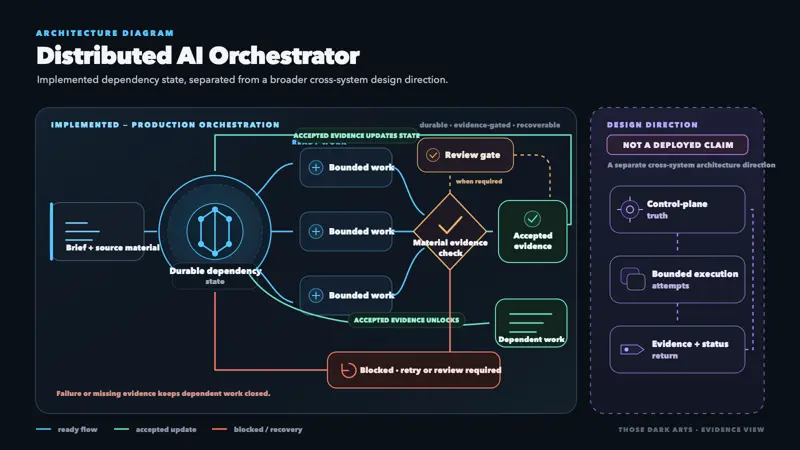
Distributed AI Orchestrator
A recoverable orchestration system for multi-step production work, using dependency state, material evidence and human review to decide what can proceed.
Long production runs become fragile when coordination exists only in transient instructions or a single live session. An interruption can erase context, a partial result can be mistaken for completion, and downstream work can start before its prerequisites are genuinely ready.

The implemented successor turns each production brief into bounded work connected by an explicit dependency graph. Readiness is computed from durable task state, so independent work can proceed while dependent work remains closed until its prerequisites are recorded complete.
Completion requires material evidence from the run. Missing or unsupported output stays blocked; durable state supports retry or operator intervention, and review gates can return affected work for revision without discarding work that remains valid.
A broader cross-system execution layer is a separate architecture direction. It is shown as a proposed extension of the same control-state and evidence principles, not as a deployed capability.