Build logs, incidents and findings from systems tested in practice.
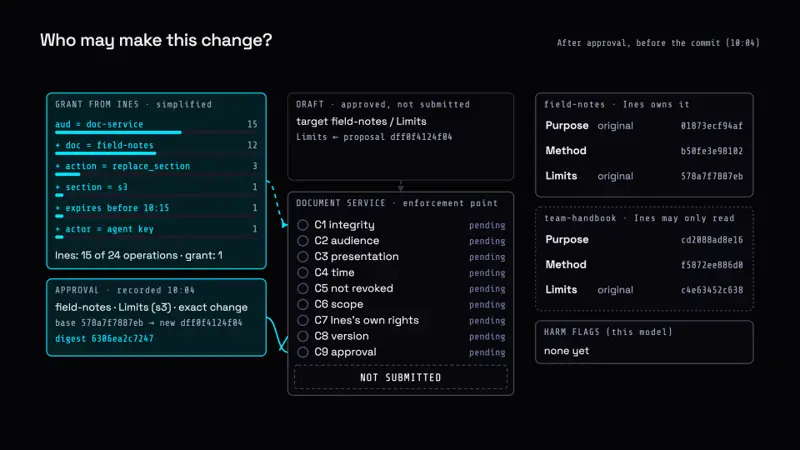
An agent is asked to rewrite one section of someone’s document, and the owner approves its draft. Follow that one edit to the moment it is written, and see what the grant, the approval and the component that performs the write each have to check, and what slips through when an approval names a section instead of a version.
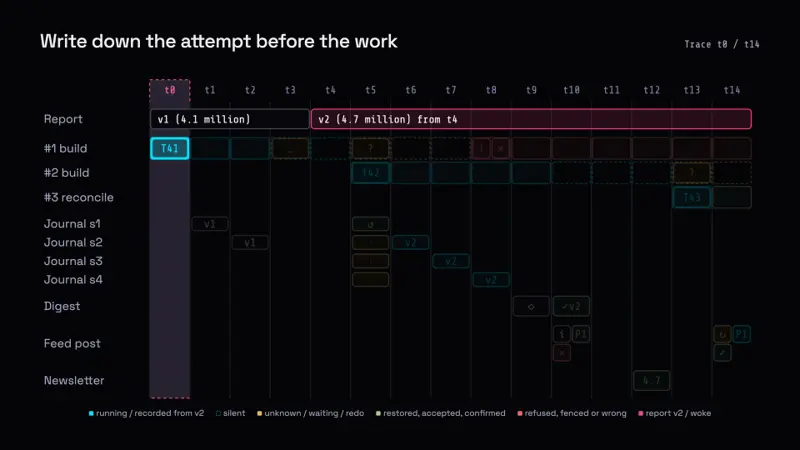
One small task, followed through a crash, a corrected input and a retried side effect: which records let someone else carry on without losing progress, repeating what cannot be undone, letting a presumed-dead worker write, or trusting a result built from the wrong input.
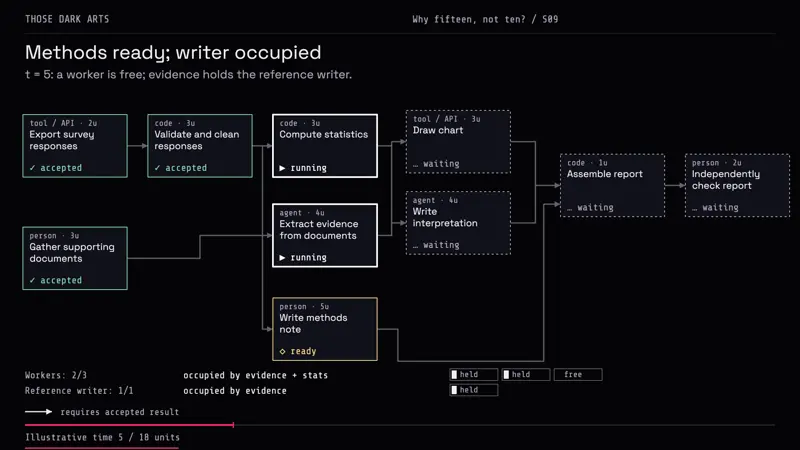
Graph engineering and orchestration: what an arrow means, which work can overlap, why a ready task still waits, what survives an interruption, and who decides a finished result can be used.
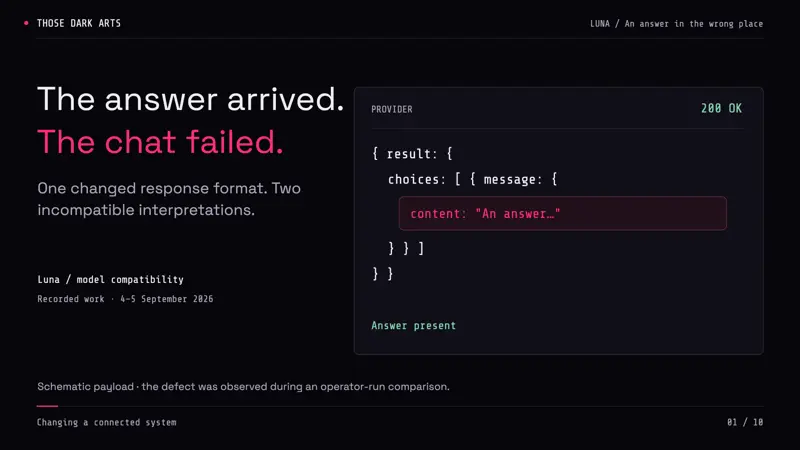
A valid model answer became a chatbot failure because its response format had changed. The repair shows how a small interface assumption can spread through a system—and how a work graph helps carry the change.
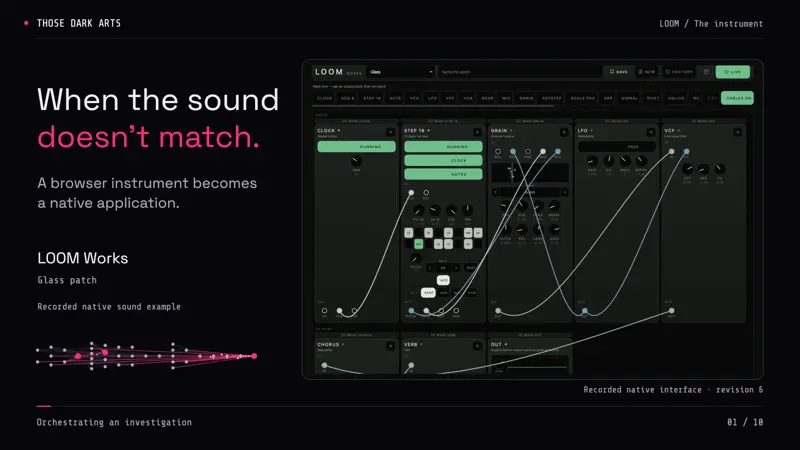
Taking a modular instrument from the browser to C++ exposed a tiny difference in when an oscillator stopped. Finding it required several investigations to meet at one explanation.
Choosing tools is not the end of design. After a graph-shaped way of working is available, something still has to hold the drawing, advance the pieces that are ready, and decide whether what came back was acceptable.
Why “I turned that off” reports a belief rather than a verified state—and how practitioners can inspect the real surface of privacy, synchronisation and retention controls.
Taking apart what people hear as an artificial voice — and asking how much of it four of our own productions can actually account for.
What a working machine is worth when the system, not the specification sheet, assigns its role
When a finished production returned the wrong article, the rejection became part of the work: recursive judgment, not a discarded miss.
Long-horizon AI work fails when the session is the system. Decisions, drafts and disputed sources need a production form that outlives the chat.
A dependency graph can expose eligible work, but it cannot schedule a worker, define material completion or grant human authority. Here is how to separate the DAG, node contracts, runtime and revision lifecycle.
A folder of stills does not want a conversation. Three questions before any tool, four ways to run the job, and a diagnostic you can fill in on paper.
You typed the client's new address into three systems and missed the fourth. What that condition costs, why the standard fix quietly changed, and what it concretely means for two systems to talk.
A teardown of our own generated-content corpus — spin versus real. We counted both stores, drew a seeded sample of fifty, and read them. The number in the title was wrong.
A folder of documents is still crawling through its queue hours after the result stopped needing human attention. The delay is a quieter decision: each item waits, although the items do not depend on one another.
How to tell whether a capability has actually transferred — a practical diagnostic, a first-win method, and a humane next step for independent builders and small teams.